Why Your PhD Resume Doesn’t Get Callbacks (And It’s Not What You Think)
A practical look at why richly credentialed PhD, MPH, and HCLS professionals often get ghosted — and how to translate expertise into a business narrative that gets noticed.
Real Edge Coaching • LinkedIn Article • realedgecoaching.com
You have the credentials. You have the experience. You’ve probably spent years solving problems that most hiring managers couldn’t even articulate.
And yet your resume is getting ghosted.
You’ve been told it’s the market. Or that you need more keywords. Or that the ATS is filtering you out before human eyes ever see your name.
Those things might be partially true. But they’re not the real reason.
The real reason your PhD resume isn’t getting callbacks is that it’s written for the wrong audience — and answering the wrong question.
Your Resume Is Answering “What Did You Do?” When Hiring Managers Are Asking Something Else Entirely
Here’s the question every hiring manager, every recruiter, and every executive reading your resume is actually asking:
“What’s In It For Them?”
Not: what did this person study?
Not: what responsibilities did this person hold?
Not: how impressive is this person’s publication record?
But: what specific business, clinical, or organizational problem does this person solve — and how do I know they’ve done it before?
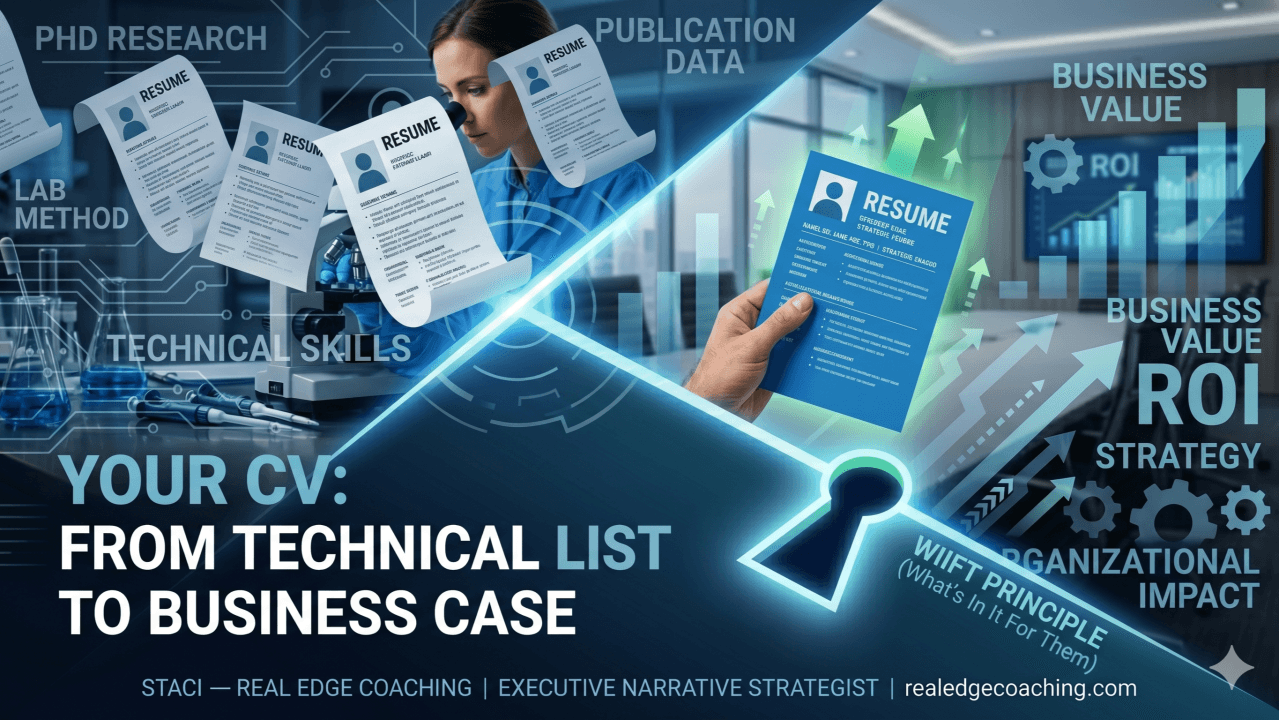
This is the WIIFT principle — What’s In It For Them — and it is the single most important shift a PhD, MPH, or PharmD can make when transitioning out of a purely technical or academic role.
Most highly credentialed professionals write resumes that answer the question they’re most comfortable with: the story of their own expertise. Their methods. Their outputs. Their responsibilities.
But the person reading your resume isn’t evaluating your expertise in a vacuum. They’re asking: “Can this person help us? Can they see our problems the way we see them? Will they speak our language in a meeting, or will they need translation?”
When your resume doesn’t answer those questions immediately and clearly, it gets passed over — not because you’re underqualified, but because you sound like a scientist when the role needs a strategist.
The “Responsibility-Bot” Problem
There’s a pattern I see consistently in resumes from HCLS professionals — PhDs in biotech, MPHs in health systems, PharmDs in clinical or regulatory roles. It looks something like this:
The Responsibility-Bot Resume (What Most PhDs Send)
- Conducted preclinical studies to evaluate therapeutic candidates across multiple disease indications
- Managed cross-functional team to ensure timely delivery of project milestones
- Responsible for preparation of IND filings and regulatory submissions
- Led data analysis and interpretation of Phase II clinical trial results
Sound familiar? This is a task list. It tells the reader what you touched. It does not tell them what changed because of you.
Now compare that to a resume written through the WIIFT lens:
The Business Narrative Resume (What Gets Callbacks)
- Accelerated IND submission timeline by 6 weeks by redesigning the cross-functional data review process, enabling earlier Phase I initiation and protecting a critical regulatory milestone
- Identified a translational gap in Phase II data interpretation that had stalled internal alignment; reframed the analysis around clinical endpoints rather than mechanistic markers, restoring stakeholder confidence and advancing program to Phase III decision
Same person. Same experience. Completely different signal to the reader.
The second version doesn’t just describe what you did. It tells the reader what was at stake, what you saw that others missed, and what became possible because of your contribution. That’s not bragging — that’s business fluency.
And in a market saturated with AI-generated resumes that all hit the same keywords and follow the same templates, business fluency is now the rarest and most valuable signal a candidate can send.
Why This Is Harder for PhDs Than Almost Anyone Else
The problem isn’t that you lack impact. The problem is that your training actively worked against this kind of self-presentation.
Academic and scientific culture rewards precision, rigor, and methodological humility. You were trained to describe what you did accurately, to not overclaim, to let the data speak for itself. Those are genuinely good values in a lab or a research environment.
But in a hiring context, that same instinct reads as:
- Passive — “was responsible for” instead of “drove,” “resolved,” “rebuilt”
- Task-focused — describing the work, not the outcome or the decision that created it
- Inward-facing — optimized for scientific peers, not for executives who need to see business value
I call this the Translation Gap. It’s not a credentials gap — your credentials are often extraordinary. It’s not a skills gap — you likely have more relevant transferable skills than you’ve been able to name. It’s a language gap. And language gaps are fixable.
The most common thing I hear from HCLS clients after we do this work: “I had no idea I’d done all of that. I just thought I was doing my job.”
That’s the blind spot. Not that you haven’t delivered business value — you almost certainly have. It’s that scientific training makes it nearly invisible to you, even as you’re doing it.
The SCAR Method: From Task List to Business Case
The framework I use with clients to bridge this gap is called the SCAR Method. It’s a four-part structure for turning any technical or scientific accomplishment into a compelling business narrative:
S - Situation - Set the stakes
What was the context, the pressure, or the problem that existed before you acted?
C - Complication - Names the problems
What was the specific obstacle, gap, or decision point that required your intervention?
A - Action - Shows your agency
What did YOU specifically do — not your team, not your department — that addressed it?
R - Result - Highlights the value delivered
What changed, improved, accelerated, or was protected because of what you did? Quantify if possible.
The SCAR Method isn’t a template to fill in. It’s a thinking framework — a way of excavating the business logic that already exists in your experience but has never been surfaced in language that a non-scientist hiring manager can immediately grasp.
When you apply it consistently, something shifts. Your resume stops reading like a record of what you’ve done and starts reading like a brief for what you’ll do next. That’s the difference between a task list and a business case. And that difference is what gets you the callback.
This Is Not About Dumbing It Down
I want to be direct about something, because I hear this concern from almost every PhD I work with:
This is not about hiding your expertise, minimizing your technical depth, or translating yourself into something less rigorous to appeal to a less sophisticated audience.
The goal is the opposite. The Trusted Advisor that HCLS organizations are looking for — in strategy, medical affairs, market access, health policy, program leadership — is precisely someone who has your scientific foundation AND can walk into an executive room and speak the language of decisions, tradeoffs, and business outcomes.
You already have the first part. The WIIFT shift gives you the second.
What changes is not your substance. What changes is the frame. Instead of leading with what you studied and what you measured, you lead with what was at risk, what you saw, what you did about it, and what it produced. The technical depth is still there — it’s just organized around the reader’s question, not your own.
You’re not becoming someone different. You’re finally becoming visible as who you already are.
What This Looks Like in Practice
A client I worked with recently — a PhD-level scientist in biopharma — had been applying for strategy and market access roles for several months. Strong background, top-tier institutions, real cross-functional leadership experience. Getting ghosted consistently.
We spent time going through the SCAR framework on her actual work history. Within the first conversation, she identified three contributions she had never put on a resume because she’d categorized them as “just part of the job” — including a competitive landscape analysis she’d built from scratch that directly shaped a portfolio decision, and a process redesign that cut a recurring regulatory delay in half.
She submitted a rebuilt resume to Scholar Rock. Interview within 48 hours.
Same credentials. Same experience. Completely different story.
The Takeaway
If your PhD, MPH, or PharmD resume is not getting callbacks, ask yourself honestly:
- Is my resume telling the reader what I did — or what I delivered?
- Am I writing for a scientific peer reviewer — or for an executive who needs to justify a hire to their CFO?
- Does each bullet answer “What was at stake, and what changed because of me?” or just “What was I responsible for?”
If the honest answer is the first option in each of those pairs, the problem isn’t your experience. It’s your translation.
And translation is fixable.
Find Your Way — Start the Translation
Find Your Way is an AI-guided workflow that helps HCLS professionals name the roles, markets, transferable strengths, and proof points that fit their background — then turns them into a professional Word document you can use before you update your resume, LinkedIn, or application strategy.
It’s not a resume template. It’s the WIIFT shift, applied to your specific background, in your own language.
Learn more at realedgecoaching.com
Staci — Real Edge Coaching | Executive Narrative Strategist | SCAR Method | realedgecoaching.com