The $725B "Leakage": Why AI's Biggest Job Boom is Happening Outside of Big Tech
Big Tech layoffs are only part of the AI story. The real job growth is rotating into healthcare, finance, retail, energy, and other verticals that need AI orchestrators.
For the last three years, the headlines have been dominated by two things: massive AI breakthroughs and massive Big Tech layoffs.
If you only looked at the surface, you would think the "AI Revolution" was a closed loop: Big Tech builds the tools, keeps the profits, and trims the headcount.
But the data from May 2026 tells a different story.
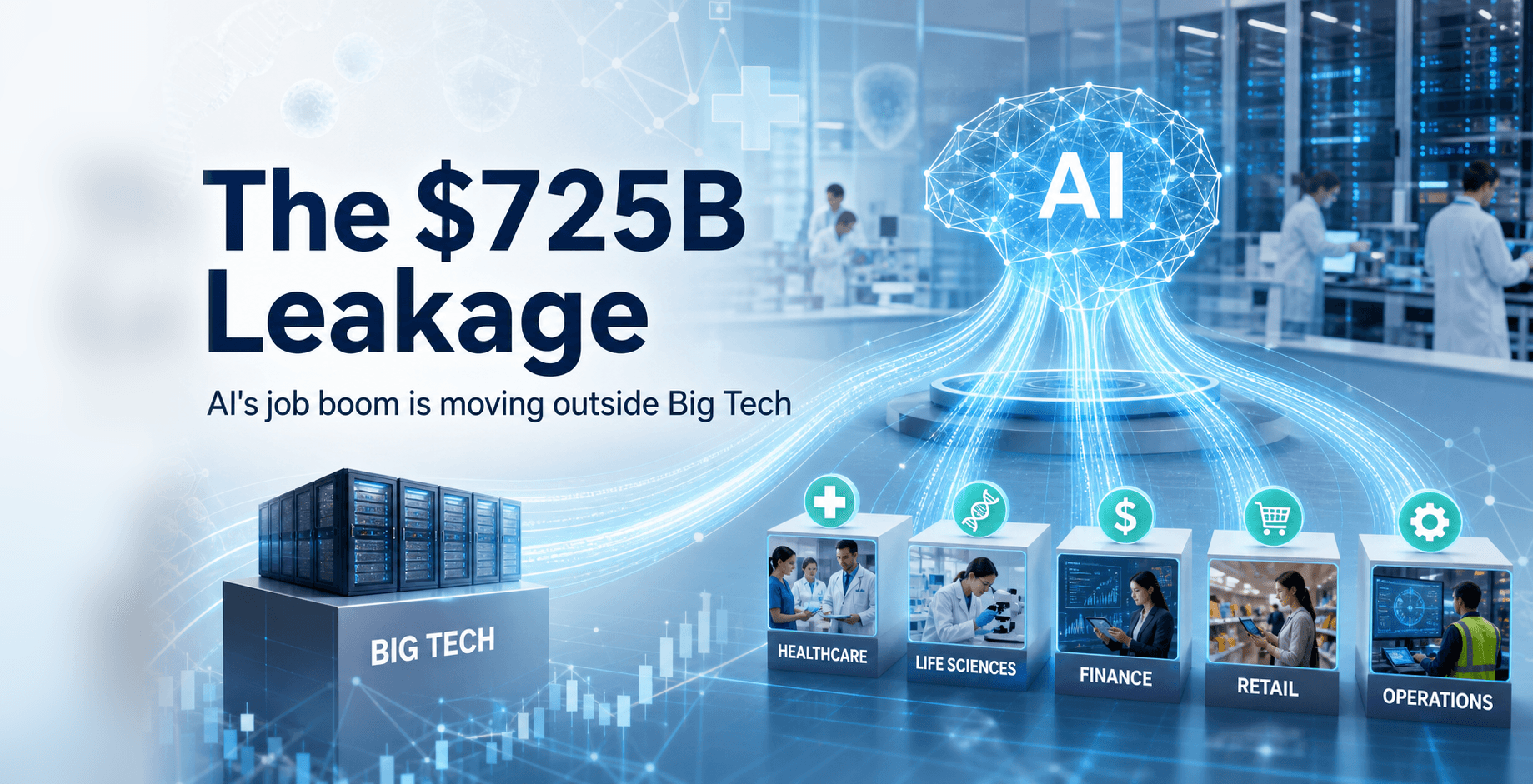
We are witnessing a massive "Capital Leakage." The billions being spent by the "Big Four" on infrastructure are now leaking into the broader economy, creating a "New-Collar" job market that rewards orchestration over execution.
Here is the breakdown of where the money is going and where the jobs are moving, backed by the latest reports from CompTIA, LinkedIn, and Morgan Stanley.
1. The numbers: rebound vs. rotation
According to the CompTIA State of the Tech Workforce 2026 report, the tech labor market is officially rebounding. After a contraction in 2025, the U.S. is projected to add 185,000 net new tech jobs this year.
However, the rotation is the real story:
- The AI signal: In January 2026 alone, there were over 275,000 active job postings requiring AI skills.
- The location shift: While Silicon Valley remains a hub, the fastest growth is now in Texas (+32,000 jobs), Florida, and New York.
- The 10-year outlook: CompTIA projects that demand for data scientists and analysts will grow by 420% over the next decade as companies move from "buying AI" to "integrating AI."
2. The $725B gravity well
Why is this happening? Look at the CapEx.
Morgan Stanley's 2026 Infrastructure Report notes that the major hyperscalers have committed roughly $740 billion to capital expenditures this year, a 69% increase over 2025.
This spending is acting as a "gravity well" for the rest of the economy:
- Second-order beneficiaries: Morgan Stanley economists point out that AI CapEx is responsible for nearly 3% of total U.S. GDP growth.
- The leakage: This money is not just staying in the cloud. It is flowing into energy grid construction, HVAC for data centers, and specialized industrials.
- Banking and finance: Banks are seeing a massive revenue spike as they finance this $740B buildout, leading to a hiring surge for AI-fluent financial advisors and wholesale bankers.
3. The LinkedIn pivot: from "doer" to "orchestrator"
LinkedIn's May 2026 Labor Market Report confirms that the "New-Collar" era has arrived. Over the last two years, 1.3 million AI-enabled jobs have been created globally.
The premium has officially moved:
- The skills gap: 86% of companies report they lack "talent velocity," the ability to find people who can actually implement these tools.
- The orchestration premium: Jobs requiring "AI literacy," including prompt engineering and AI pipeline management, grew 70% year over year.
- Human strength: 75% of global companies now prioritize human skills, including adaptability, communication, and prioritization, over pure technical execution.
As one KPMG executive put it: "AI transformation is as much about people as it is about technology."
4. Stability in the non-tech verticals
If you are looking for stability, Goldman Sachs Research suggests looking outside of traditional software companies.
The tech sector's share of the total employment mix has actually fallen below its long-term trend.
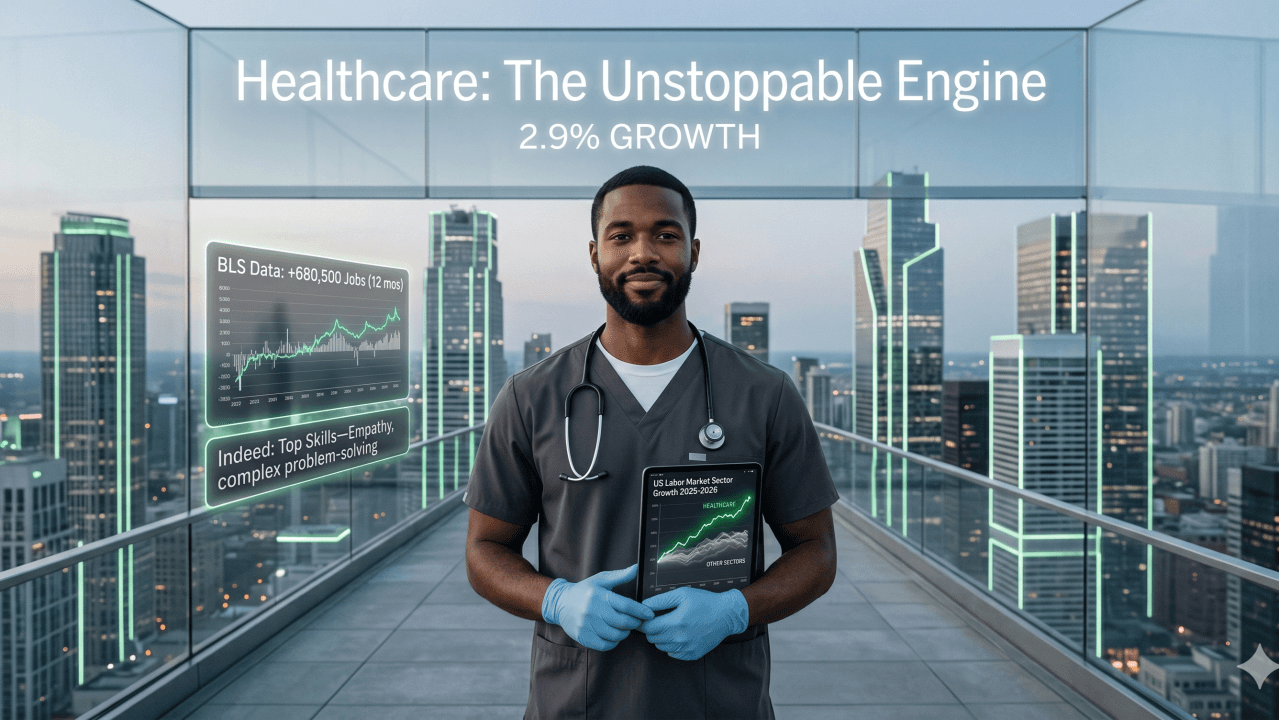
Conversely, sectors like healthcare, finance, and retail are seeing a sharp acceleration in hiring. These companies are not building the brain, the LLM. They are hiring specialists to build the body, the implementation, around it.
The career takeaway for 2026
Stop describing yourself as a "reliable doer."
In a world where execution is increasingly automated, the market is rewarding the orchestrators.
The gold rush is still on, but the demand has moved. It is no longer about who sells the software. It is about who uses the $725B infrastructure to improve systems, steer outcomes, and extend human judgment.
Are you showing how you improve the system, or just how you perform a task?
Sources
- CompTIA State of the Tech Workforce 2026
- Morgan Stanley 2026 Economic Outlook & AI CapEx Reports
- LinkedIn Economic Graph: 2026 Labor Market Report
- Goldman Sachs Research: How Will AI Affect the US Labor Market? (March 2026)
- Stanford HAI: The 2026 AI Index Report
#AI #TechJobs #FutureOfWork #CareerStrategy #Leadership #2026LaborMarket