Healthcare: The Unstoppable Engine of the 2026 Labor Market
Healthcare added 680,500 jobs in twelve months, making it one of the clearest bright spots in the 2026 labor market for clinical and non-clinical career moves.
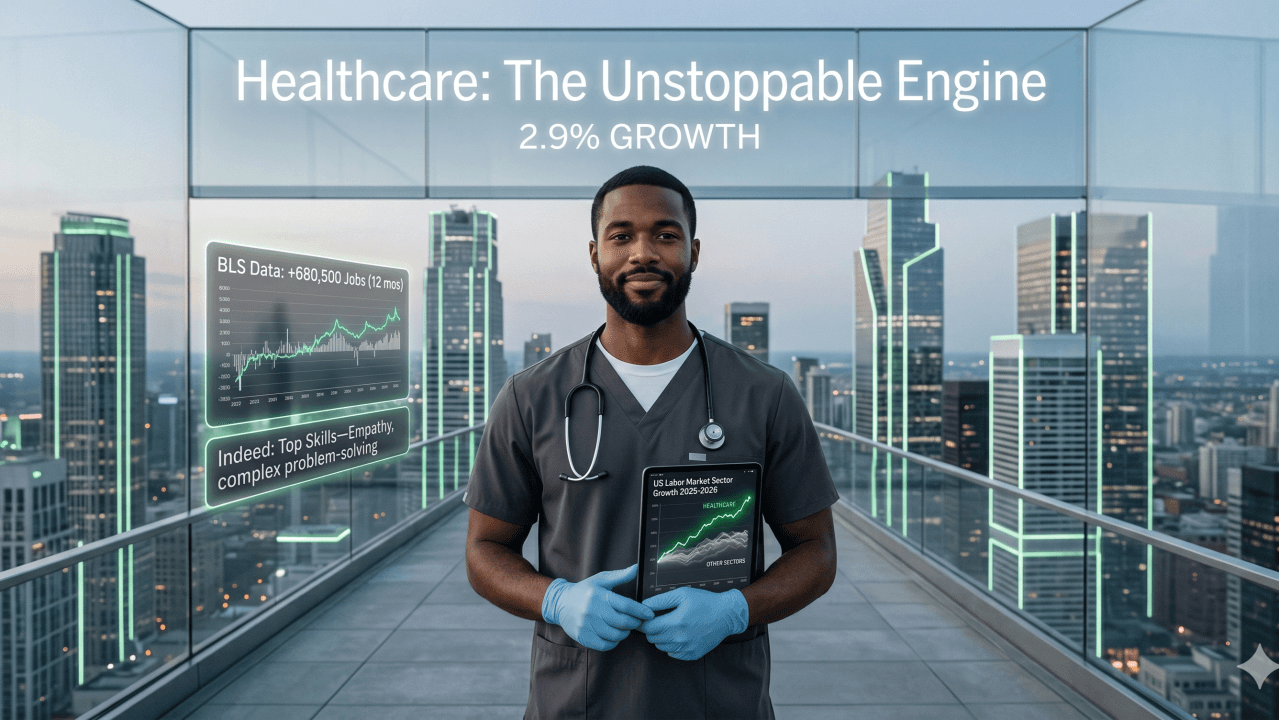
For job seekers: now is a great time to lean into the healthcare space.
Recent data from the Bureau of Labor Statistics (BLS) and Indeed's 2026 Hiring Lab outlook reveal that healthcare is not growing at its expected rate of 1% or less. Employment in the healthcare and social assistance sector has scaled by 2.9% between March 2025 and March 2026.
It is unusually dominant.
The demand is not limited to clinical roles. There is a massive need for administrative, technological, and support staff who can navigate the complexities of modern care.
Here are the key takeaways from the latest reports on why healthcare is the sector to watch this year.
1. Healthcare and social assistance is one of the largest employers in the United States
The sector employs over 20 million people.
While other sectors struggle, the April 2026 BLS report highlights an additional 680,500 jobs added to the economy in just twelve months. Economists find these numbers staggering because the industry is growing despite a massive labor shortage.
The hiring increase amid high vacancy rates and burnout suggests an almost desperate level of demand from providers to keep up with an aging population, the "Silver Tsunami."
It shows that healthcare is operating on a different economic engine than the rest of the country.
In fact, right now healthcare is providing a stable floor for the national labor market as a primary driver of total nonfarm payroll gains.
In short: 2.9% is not just a number. It represents a massive structural shift where healthcare is effectively carrying the American labor market on its back.
2. Healthcare still needs human-centric skills
While AI is transforming cognitive and analytical work in finance and professional services, healthcare relies heavily on social and soft skills that are difficult to replicate.
Indeed's 2026 Jobs & Hiring Trends Report underscores a structural advantage for healthcare: it is largely automation-resistant.
Top skills in demand include communication, empathy, and complex problem-solving. These remain among the most requested skills in healthcare postings.
Indeed also notes that sectors requiring high levels of interpersonal interaction, like healthcare and education, are seeing some of the most consistent wage growth and job stability.
3. Healthcare is a sector of resilience
Historically, healthcare has been seemingly impervious to market-oriented efforts to constrain costs or economic downturns (NCBI, 2021).
With unemployment rates in nursing rarely exceeding 1.5%, the sector remains a safe haven for job seekers.
As the population ages and the demand for public health interventions rises, the U.S. will need to add millions of new jobs in this space through the end of the decade (Kedia et al., 2023).
What this means for us
Healthcare is not just a part of the economy. In 2026, it is the economy's North Star.
#HealthcareHiring #JobTrends2026 #BLSData #FutureOfWork #HealthcareInnovation
References
Kedia, S. K., Entwistle, C., Lee, G., Magana, L., Burke, E. M., & Joshi, A. (2023). Expectations of employers in the United States for entry-level public health job skills with a bachelor's degree: an analysis of the positions advertised in an online job portal. Frontiers in Public Health, 11. https://doi.org/10.3389/fpubh.2023.1218509
National Academies of Sciences, Engineering, and Medicine. (2021). The Nursing Workforce. In The Future of Nursing 2020-2030: Charting a Path to Achieve Health Equity. National Academies Press. https://www.ncbi.nlm.nih.gov/books/NBK573922/